Competitive Personal Responsibility Education Program (C-PREP) and Tribal Personal Responsibility Education Program (Tribal PREP) grants have been released.
Application deadline is Monday, August 31, 2026.
Organizations in the following states are eligible to apply for the 2026 C-PREP Grants:
- California
- Florida
- American Samoa
- Marshall Islands
Federally recognized Indian tribes and tribal organizations are eligible to apply for Tribal PREP.
PREP grants support projects that focus on reducing teen pregnancy, HIV, and STI rates among youth aged 10 – 19 (and pregnant/parenting youth under 21) by educating them on both abstinence and contraception. Funding guidelines mandate that, at a minimum, 3 of 6 Adult Preparation Subjects (APS) be covered.
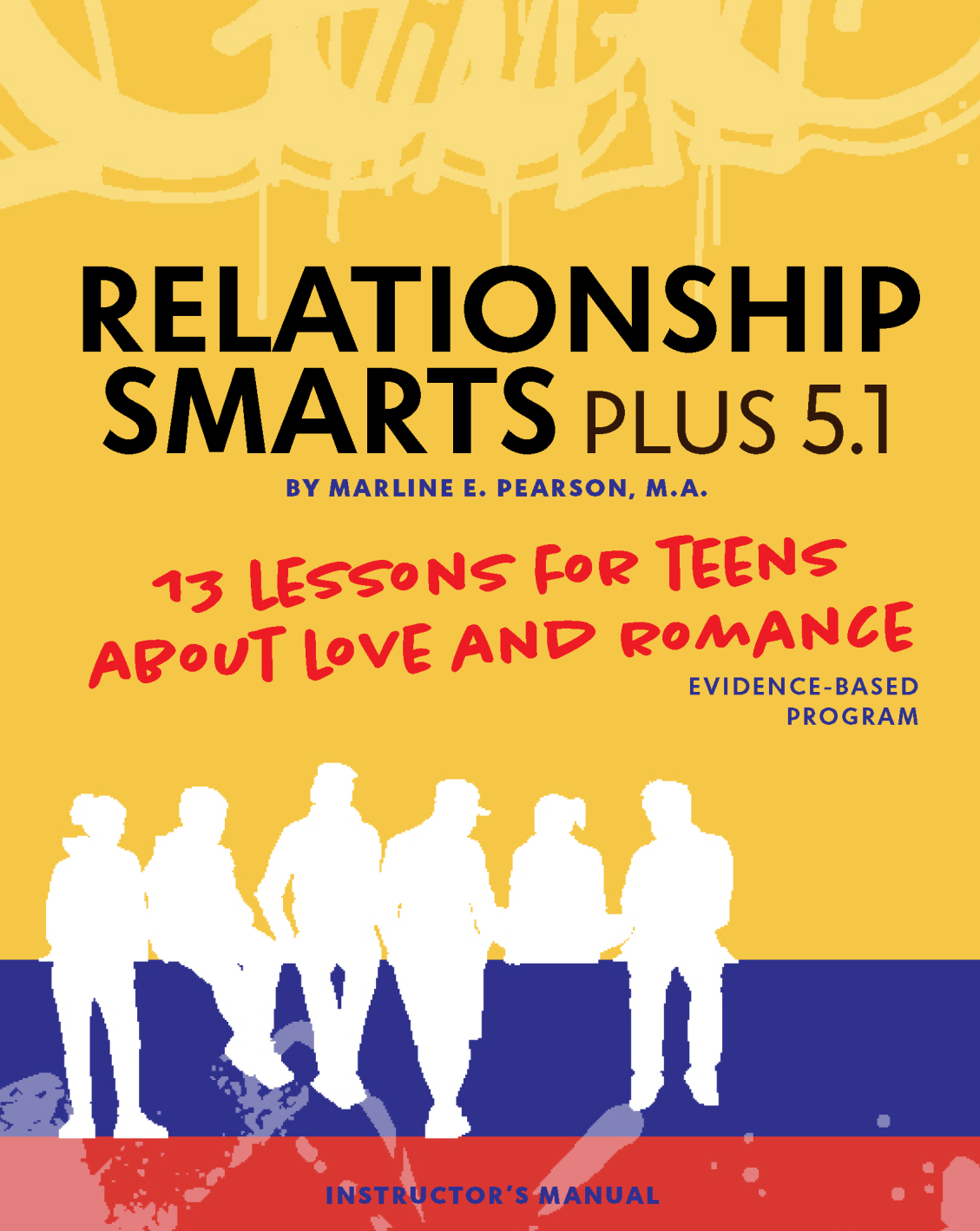
Love Notes 4.1 CSE and Relationships Smarts Plus 5.1 CSE are innovative, effective, and engaging evidence-based programs that align with these federal funding opportunites!
Both programs:
- Cover five of the six Adult Preparation Subjects
- Include supplemental content that allows facilitators to be culturally adaptive.
Money Habitudes covers the sixth Adult Preparation Subject!
If you would like to add additional trauma-based instruction for your young people, consider supplementing with Mind Matters 2.0 – A Map for Thriving!
For more details on Love Notes 4.1 or Relationships Smarts Plus 5.1, please explore the information included in this toolkit!If you need further information, please reach out to Jonelle Zachary, Outreach Coordinator.
- Evidence-Based Program/Data
- Adult Preparation Subjects
- Tribal PREP
- Logic Model
- Trauma-Informed Care
- Medical Accuracy
- Body Literacy
- Bonus Points - ACF Alignment
- Human Trafficking Universal Education
- Populations - Settings
- Case Studies
- Outcomes
- Fidelity Tools
- Training Expectations
- Technical Assistance
- Teaching Supply List
- Materials and Training Budget
- Memorandum of Understanding (MOU)
- Issue Brief
Key Outcomes:
Key Outcomes:
Tribal Personal Responsibility Education Program (PREP)!
Tribal PREP grants support projects that educate American Indian/Alaska Native youth ages 10-19, and expectant and parenting youth under age 21, on both abstinence and contraception for the prevention of pregnancy while also promoting the successful transition of youth to adulthood through education on key adulthood preparation topics within the cultural context that is most appropriate for those youth.
Consulting with elders and your community on curriculum decisions and your implementation plans is a high priority. Please consider reviewing cases studies on how other tribal communities have successfully used and adapted Dibble programs to fit their culture.
Check out our Case Studies below!
Goal: Violence Prevention
Funding: Office of Violence against Women
Setting: School, Camp
Curriculum: Love Notes
Goal: Increase knowledge of healthy relationships
Funding: Healthy Marriage and Responsible Fatherhood (OFA)
Setting: Reservation high school and YFS center
Curriculum: Relationship Smarts Plus
Check out our Indigenous Youth Toolkit!
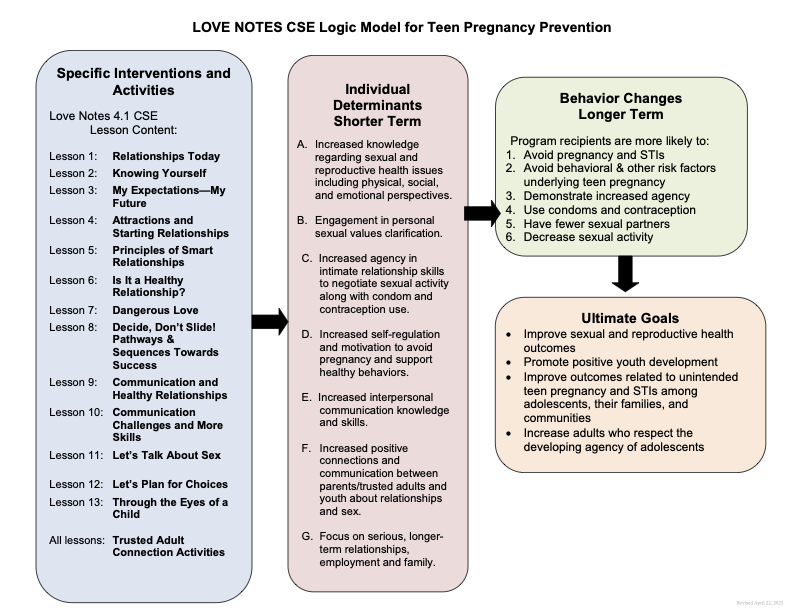
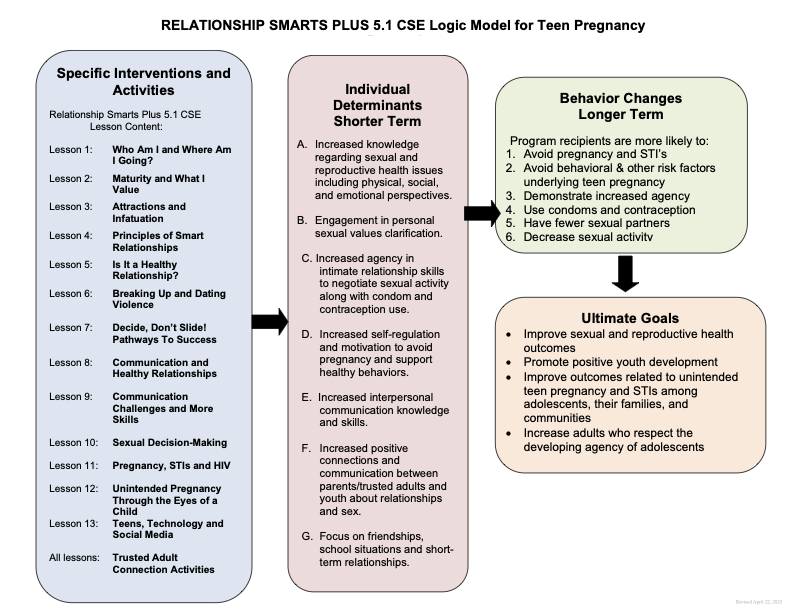
Love Notes and Relationship Smarts PLUS were designed with two trauma-informed goals in mind:
- To directly empower youth: Help teens and young adults who have experienced childhood adversity to make meaning of their pasts by looking at the patterns they experienced to better understand how these earlier events have influenced their lives and choices. Most importantly, to support youth in defining what they want in their relationships, their present or future family, and for their life goals. Yet defining isn’t enough. It is essential to equip young people with the knowledge and skills to build self-efficacy and confidence to move towards their goals.
- To prevent of Adverse Childhood Experiences in the children these youth have or may have in the future: An important hook throughout the curriculum is how Intimate Partner Violence, unstable and turbulent relationships, and unplanned pregnancies affect children. These concepts are conveyed through upbeat and empowering activities. Vulnerable youth immediately understand the connection between family structure and outcomes for children and they long to protect to their current or eventual children. We build upon that protective, empathetic instinct. We tap their aspirations and give them a huge trove of knowledge and skills to help them move towards their aspirations.
If you want additional trauma-based tools to help the young people you serve, consider including Mind Matters 2.0: A Map for Thriving. It gives teens and the adults who serve them a map for the journey toward healing—and the tools to follow it.
- Mind Matters teaches young people proven ways to deal with stressful life experiences using innovative methods based on current research and neuroscience.
- Students experiencing ongoing stress or prior trauma often have difficulty regulating their emotional responses when facing challenges in school and work, life and relationships. As youth learn the skills and strategies in Mind Matters, they can begin to take charge of themselves and their responses to what life throws at them. Teens learn to address their physical, relational, and mental health needs.
- Mind Matters may be taught by non-clinicians in group or individual settings with teens (12 and up) to build skills that help them cope with life’s stressors. The program can be successfully implemented in health classes, home visiting settings, career and technical ed programs, parenting classes, residential group homes, corrections, staff development seminars, and more.
The Dibble Institute has developed trauma-informed teaching tips for program managers and educators. Download the tips here.
A contractor for the Family and Youth Services Bureau (FSBY) recently reviewed and approved Love Notes for medical accuracy.
We would be pleased to work with you on a medical accuracy review post-award.
Body Literacy Guidance
We recommend that you find modules to augment your Love Notes 4.1 CSE | Relationship Smarts PLUS 5.1 CSE implementation, which cover all the requirements needed to support Body Literacy education.
For additional details or clarification, email Aaron @ Dibbleinstitute.org
Alignment with ACF vision, mission, values, priorities, and guiding principles (Up to 10 Points)
ACF’s published Vision, Mission, Values, Priorities, and Guiding Principles inform programmatic and administrative expectations under this funding opportunity.
Applicants must demonstrate alignment by describing how the proposed project advances relevant ACF priorities through program design and evaluation. Applicants should clearly identify which ACF priorities are relevant and explain how those priorities are reflected in the proposed approach.
The chart below shows how Love Notes and Relationship Smarts PLUS support the ACF values. You will need to expand this with how your organization and grant activity support the values.
| Promoting Work & Self-Sufficiency – PREP emphasizes personal responsibility, goal-setting, and future orientation. PREP explicitly links behavior to poverty prevention and economic independence. | Both programs teach a powerful set of evidence-based skills to improve communication, negotiation, and the handling of conflict. These skills are adapted from PREP, the Prevention and Relationship Enhancement Program. Youth practice new ways to handle anger and regulate strong emotions. They learn a technique for how to talk through difficult or sensitive issues. They learn how to more effectively raise issues and complaints, recognize hidden issues, and solve problems within their relationships.
These communication skills are essential in increasing successful and cooperative interactions in the workplace, increasing job retention, and improving economic independence. |
| Promoting Marriage & Family Formation – PREP has a strong focus on promoting healthy relationships that lead to stable marriages and families, which directly aligns with ACF priorities. | Love Notes 4.1 CSE and Relationship Smarts PLUS 5.1 CSE are built around helping youth gain the knowledge and skills for engaging in healthy relationships. In doing so, our programs provide youth with the foundation for stable marriages and families.
Marriage and family formation are continually reinforced as positive, aspirational life goals – not a passing reference. |
| Gold-Standard Research – Research and evaluation conducted under PREP must be rigorous. PREP provides opportunities for independent local evaluation and conducts rigorous national evaluation which is fully aligned with ACF priorities. | Love Notes was evaluated in a 5-year $4.8 million study through the University of Louisville. It is considered to be evidence based on statistically significant decreases in sexual activity, and avoidance of pregnancy (46% less likely) as well as an increase in the likelihood that teens would choose to remain abstinent and for those who were already sexually active an increase in the likelihood they would stop having sex.
Relationship Smarts PLUS also underwent an evaluation in which the results revealed that 3 years after the program, girls who participated in Relationship Smarts PLUS were significantly less likely to have had sex without a condom in the last three months than those in the control group. The author and publisher would welcome and fully support additional gold-standard evaluations of Love Notes 4.1 CSE and/or Relationship Smarts PLUS 5.1 CSE. |
Love Notes 4.1 CSE covers sex trafficking in a section of Lesson 7 “Dangerous Love” and Relationship Smarts PLUS 5.1 CSE covers this in Lesson 6 “Breaking Up and Dating Violence.” Both lessons include discussions around risks for trafficking, how to identify potential trafficking schemes, and skills to build one’s safety, seek help and support, and provides examples of national resources available to youth.
In order to cover other areas of human trafficking, we suggest you explore and consider including information from the resources provided in the NOFO.
Love Notes and Relationship Smarts PLUS are being successfully implemented with many youth across a wide variety of settings. Below is a partial list of populations and settings where Love Notes and Relationship Smarts PLUS are being used.
For more details about implementation settings and populations, review case studies here.
Settings
- System engaged youth
- Group homes (Foster)
- Residential settings (Mental health)
- Detention centers
- Challenge academies
- Schools, including classes for pregnant and parenting teens
- Alternative schools
- Faith-based settings
- Community agencies
Populations
- Youth living in areas with high rates of teen births and STIs
- Youth in, or aging out, of foster care system
- Youth who are victims of trafficking
- Risk-immersed youth
- Pregnant and parenting teens (both fathers and mothers)
- Youth in correctional settings
- Tribal youth
- Runaway and homeless youth
- Community college students
- Youth who have been abused
PREP Case studies
Goal: Support youth in their journey to adulthood in the best way possible
Funding: SRAE, PREP
Setting: High school classrooms in rural Kansas and Oklahoma
Curriculum: Love Notes Classic and SRA
Goal: To diminish occurrences of pregnancy, HIV, and STIs among high-risk youth aged 10 to 19 (up to 21 for those who are pregnant and/or parenting) in Georgia
Funding: State of Georgia PREP Funding
Setting: Public High School Setting
Curriculum: Love Notes 4.0
Goal: Positive Youth Development
Funding: PREP Funding
Setting: School, AVID
Curriculum: Love Notes

Goal: Implement effective goal setting skills for education and relationships
Funding: Personal Responsibility Education Program
Setting: Pregnant and parenting teens health class
Curriculum: Love Notes
Goal: Improve Relationship skills
Funding: Personal Responsibility Education Program (PREP)
Setting: Juvenile Justice Center
Curriculum: Love Notes
Goal: Implement effective goal setting skills for education and relationships
Funding: Personal Responsibility Education Program
Setting: Charter school classroom for teen moms
Curriculum: Love Notes
Goal: Healthy Relationship education and skills
Funding: Personal Responsibility Education Program
Setting: Community Based Setting with youth
Curriculum: Love Notes 2.1 and Money Habitudes
Goal: Reduce Teen Pregnancy, STI’s, and Abortion rates
Funding: County Dept of Human Services and PREP
Setting: Alternative High School health class
Curriculum: Love Notes
Pregnant and Parenting Youth Case studies
Goal: Assisting pregnant and parenting youth and young adults to avoid welfare dependance
Funding: from DOE, DHS, and TANF funds
Setting: High Schools, Community Settings, Participant’s Homes
Curriculum: Love Notes
Goal: Strengthen connections between incarcerated and their families
Funding: State funds and private donations
Setting: Prisons
Curriculum: Love Notes
Goal: Increase awareness of healthy relationships
Funding: CalWorks campus funds
Setting: Campus
Curriculum: Love Notes
Goal: Increase college graduation rates
Funding: Department budget
Setting: Community college
Curriculum: Love Notes

Goal: Increase father child connection
Funding: Responsible Fatherhood grant, OFA
Setting: Reentry rehab centers, community centers, churches
Curriculum: Love Notes
Goal: Learn importance of healthy relationships and value of planning for children
Funding: PAF and INSPIIRE grant
Setting: High school classroom for pregnant and parenting teens
Curriculum: Love Notes
Child Welfare Case studies
Goal: Addressing and mitigating trauma with high-needs youth, families, and communities.
Funding: California Behavioral Health Youth Initiative
Setting: Runaway and Homeless Youths
Curriculum: Mind Matters
Goal: Delinquency prevention, Delinquency intervention, and Delinquency accountability services for youth at risk for delinquency or affected by the correctional system
Funding: Arizona Title II Forumla Grant
Setting: Runaway and homeless youth shelters, Tribal schools, Diversion classes, PRIDE center, AIM Program
Curriculum: Mind Matters
Goal: Learn coping skills & self-care
Funding: State Medicaid, county, youth services
Setting: Residential group homes
Curriculum: Mind Matters
Goal: Knowledge to make wise relationship choices
Funding: Runaway and Homeless Youth grant
Setting: Shelter Center and Group Foster Homes
Curriculum: Relationship Smarts Plus
Goal: Gain knowledge about healthy relationships
Funding: Runaway Homeless Youth + The Children Trust
Setting: Alternative high schools, community college, homeless shelter
Curriculum: Love Notes
Goal: Increase knowledge of healthy relationships
Funding: Independent Living Program
Setting: Youth shelter
Curriculum: Love Notes
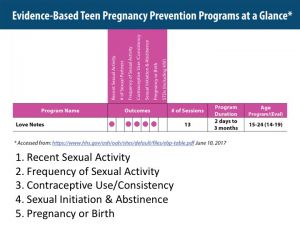
Love Notes Evidence Based Program Model is the ONLY program on the federal OAH list with five positive outcomes and no negative outcomes.
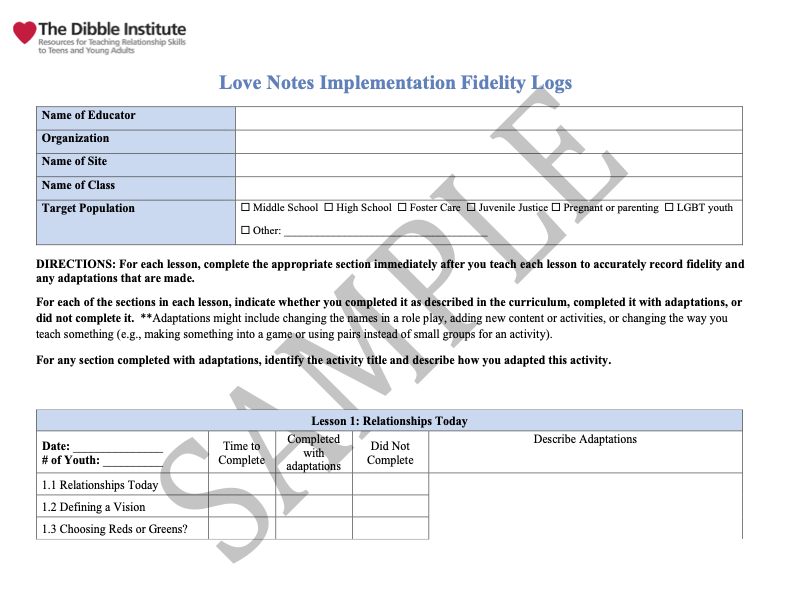
The following fidelity aids and checklists are included when you purchase the Love Notes 4.1 or Relationship Smarts PLUS 5.1 Manual:
- Annotated slide deck to focus the instructor on key content.
- Fidelity monitoring tools for facilitators, observers, and evaluators.
- Knowledge test.
The Dibble Institute offers high-quality, curriculum and professional development training for all your project staff and facilitators/educators. We also provide ongoing follow-up technical assistance to facilitators as needed. To help ensure the success of your C-PREP program implementation, we recommend the following training protocols:
1) For clients new to Love Notes or Relationship Smarts PLUS
Five day 3.5-hour per day online training or 3 full day in-person training for all instructional and project staff. Group discounts are available.
Please call Carlie Kaeppler at 800-695-7975 ext. 703 or Carlie@Dibbbleinstitute.org to obtain a training quote.
2) Clients who have attended a Dibble-certified training in a previous edition of Love Notes (3.0 or earlier) or Relationship Smarts PLUS
One day virtual or in-person training to review new, updated, and/or content unique to Love Notes 4.1 and/or Relationship Smarts PLUS.
Please call Dr. Rachel Savasuk-Luxton at 800-695-7975 ext. 705 or email Rachel@Dibbleinstitute.org to obtain a training quote.
3) Clients who have attended a Dibble-certified training in Love Notes 4.0 Classic or SRA or Relationship Smarts PLUS 5.0 Classic or SRA
Please call Dr. Rachel Savasuk-Luxton at 800-695-7975 ext. 705 or email Rachel@Dibbleinstitute.org to begin a needs assessment process and development of your personalized training plan.
**Please note: If you have trainees with varied experience attending a training, your training plan will be based on those individuals who have the least experience with Love Notes and/or Relationship Smarts PLUS
4) Clients with TOT-Certified Love Notes Trainers on staff
The Dibble Institute includes two hours of complimentary technical assistance (TA) with every Group Training Agreement. Additional TA at $95 an hour may be scheduled based on your needs.
We can help you craft a clear and realistic recruitment, retention, training, and TA plan to build capacity on topics pertinent to implementation of your SRA project and priorities listed in this NOFO for facilitators throughout the grant.
Based on your needs, TA topics could include:
- Developing a post-training plan for successful facilitation
- Handling sensitive topics
- Trauma-informed training techniques
- Improving facilitation skills
- Creating effective recruitment and retention plans
- Successful implementation models in schools and community organizations
- Identifying participant referral resources
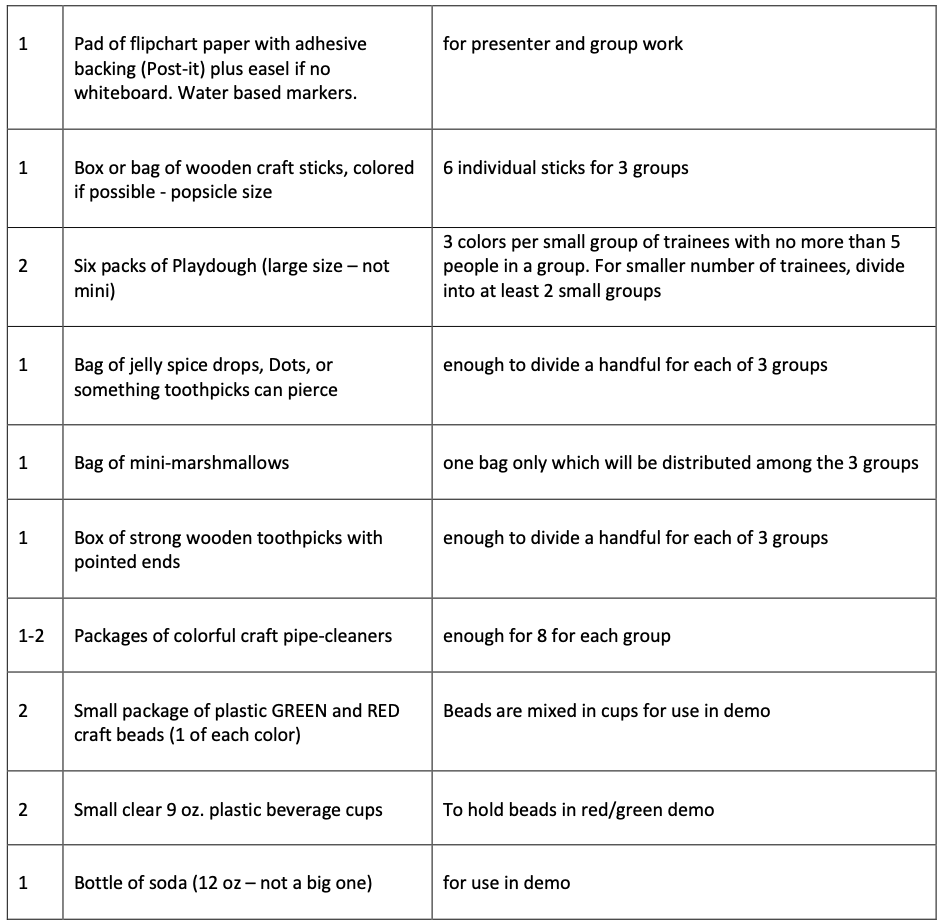
Teaching Supply List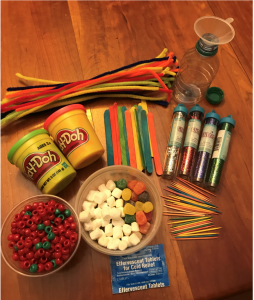
These items are necessary when teaching the curriculum. Many of the supplies can be reused.
Assumptions: 15 participants divided into 3 groups of 5. Scale the supplies accordingly with larger or smaller groups.
We ask applicants to complete this Materials, Technical Assistance, and Training Budget because we want to make sure that you have everything you need in your budget to assure success.
Please return to Aaron Larson, grant coordinator, (Aaron @ DibbleInstitute.org). He will contact you to complete your MOU with The Dibble Institute.
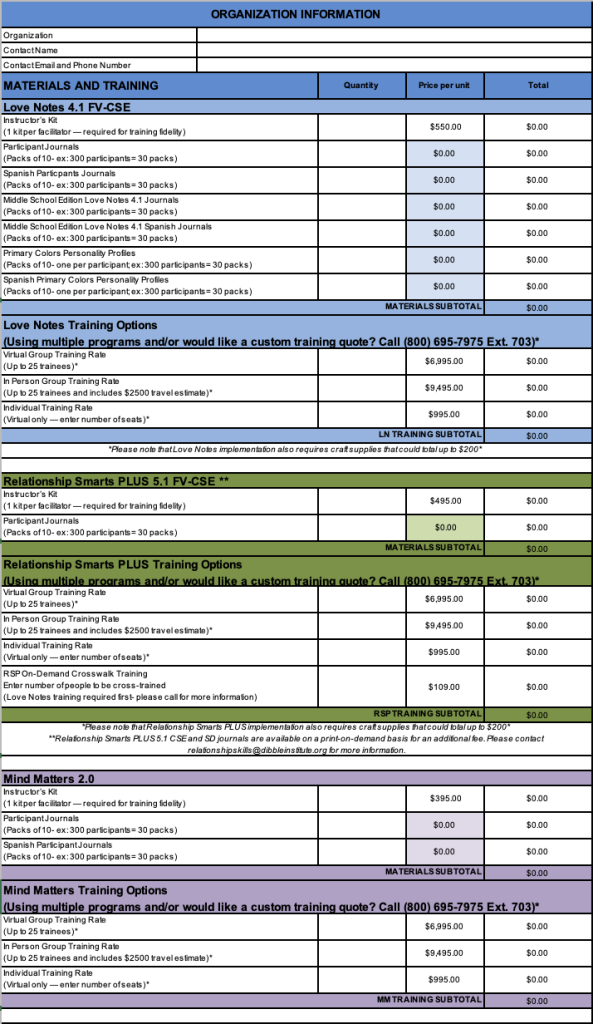
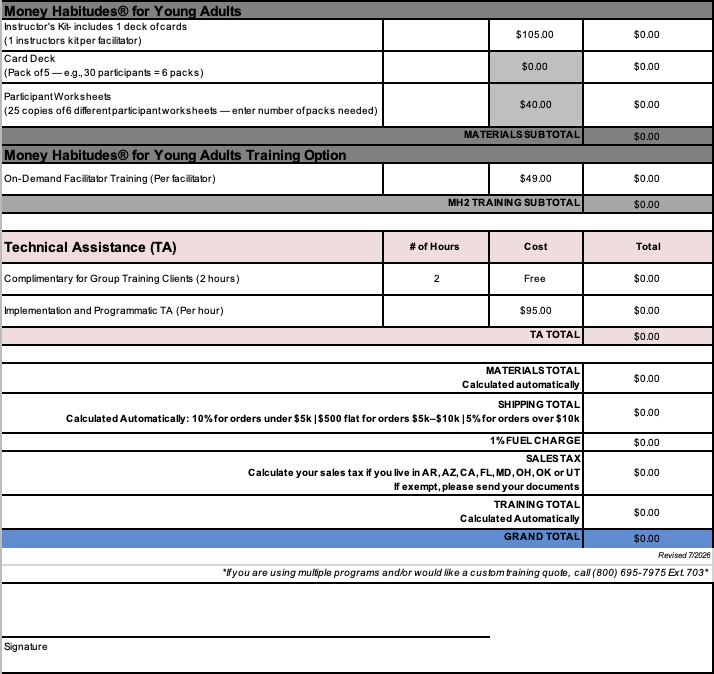
The Dibble Institute is pleased to sign an MOU with you as part of your application.
To help us understand your plans, please send an email Aaron @ DibbleInstitute.org with the following information:
- Numbers of students you plan to serve each year of the grant.
- Your signed Training and Materials Budget